 Greetings from the library!
I'm Jenny, your librarian for this course.
If you'd like some one-on-one help with research, click here to book an appointment with me, or any of the other amazing librarians with whom I share office hours.
You can also email me: jcastel@jwu.edu
Did you know you can also chat or text with one of our on-duty librarians?
It's anonymous, free, and super fast! Click on the blue button below to chat now!
chat loading...
Start here:
Academic Search Complete
- Use Academic Search to search for articles on almost any topic. Search by using keywords.
- Click Full Text on the left so you can read articles online.
- Click Scholarly (Peer Reviewed) to read academic, peer reviewed articles.
JSTOR
- Find articles covering Language & Literature, History, Art & Art History with American Studies, Asian Studies, Latin American Studies, and African American Studies.
- For access to content that JWU subscribes to, please select "Advanced Search" from JSTOR's homepage, then select "Content I can access" from the "Select an access type" drop down menu.
Credo Reference
- reference books and eBooks covering topics such as History and Social Sciences
- Search the "Tools" tab for the (historical) image library
-
 American Work
by
This is a social history of almost four centuries of competition, co-operation and exclusion. In a New World built on a foundation of tobacco, rice, timber and peas, human labour was the key to wealth and colonists knew that most labour was naturally not free. Red, white and black men, women and children could all expect hard usage by masters, husbands and fathers. As the wilderness was cultivated and economies stabilized, however, life got better - for some.
Call Number: eBookISBN: 9780393045611Publication Date: 1998-02-01
American Work
by
This is a social history of almost four centuries of competition, co-operation and exclusion. In a New World built on a foundation of tobacco, rice, timber and peas, human labour was the key to wealth and colonists knew that most labour was naturally not free. Red, white and black men, women and children could all expect hard usage by masters, husbands and fathers. As the wilderness was cultivated and economies stabilized, however, life got better - for some.
Call Number: eBookISBN: 9780393045611Publication Date: 1998-02-01 -
 Bartleby, the Scrivener
by
The classic tale of existential despair A Wall Street lawyer specializing in bonds and mortgages hires a respectable young man to copy legal documents by hand. At first, the new scrivener approaches his duties with a calm efficiency. Then comes the day when his response to a new assignment is, "I would prefer not to." The mysterious phrase soon becomes Bartleby's reply to everything asked of him, and his surrender to inertia is both maddening and inexorable. Torn between frustration and pity, anger and sorrow, his employer desperately tries to save Bartleby, but the cause is as doomed to disappointment as life itself. A strange and haunting fable that continues to resonate a century and a half after it was first published, Bartleby, the Scrivener is a masterpiece of American literature. This ebook has been professionally proofread to ensure accuracy and readability on all devices.
Call Number: eBookISBN: 9781497659704Publication Date: 2014-08-26
Bartleby, the Scrivener
by
The classic tale of existential despair A Wall Street lawyer specializing in bonds and mortgages hires a respectable young man to copy legal documents by hand. At first, the new scrivener approaches his duties with a calm efficiency. Then comes the day when his response to a new assignment is, "I would prefer not to." The mysterious phrase soon becomes Bartleby's reply to everything asked of him, and his surrender to inertia is both maddening and inexorable. Torn between frustration and pity, anger and sorrow, his employer desperately tries to save Bartleby, but the cause is as doomed to disappointment as life itself. A strange and haunting fable that continues to resonate a century and a half after it was first published, Bartleby, the Scrivener is a masterpiece of American literature. This ebook has been professionally proofread to ensure accuracy and readability on all devices.
Call Number: eBookISBN: 9781497659704Publication Date: 2014-08-26 -
 Bitter Fruit
by
Despite the participation of African American women in all aspects of home-front activity during World War II, advertisements, recruitment posters, and newsreels portrayed largely white women as army nurses, defense plant workers, concerned mothers, and steadfast wives. This sea of white faces left for posterity images such as Rosie the Riveter, obscuring the contributions that African American women made to the war effort. In Bitter Fruit, Maureen Honey corrects this distorted picture of women's roles in World War II by collecting photos, essays, fiction, and poetry by and about black women from the four leading African American periodicals of the war period: Negro Digest, The Crisis, Opportunity, and Negro Story. Mostly appearing for the first time since their original publication, the materials in Bitter Fruit feature black women operating technical machinery, working in army uniforms, entertaining audiences, and pursuing a college education. The articles praise the women's accomplishments as pioneers working toward racial equality; the fiction and poetry depict female characters in roles other than domestic servants and give voice to the bitterness arising from discrimination that many women felt. With these various images, Honey masterfully presents the roots of the postwar civil rights movement and the leading roles black women played in it. Containing works from eighty writers, this anthology includes forty African American women authors, most of whose work has not been published since the war. Of particular note are poems and short stories anthologized for the first time, including Ann Petry's first story, Octavia Wynbush's last work of fiction, and three poems by Harlem Renaissance writer Georgia Douglas Johnson. Uniting these various writers was their desire to write in the midst of a worldwide military conflict with dramatic potential for ending segregation and opening doors for women at home. Traditional anthologies of African American literature jump from the Harlem Renaissance to the 1960s with little or no reference to the decades between those periods. Bitter Fruit not only illuminates the literature of these decades but also presents an image of black women as community activists that undercuts gender stereotypes of the era. As Honey concludes in her introduction, "African American women found an empowered voice during the war, one that anticipates the fruit of their wartime effort to break silence, to challenge limits, and to change forever the terms of their lives."
Call Number: eBookISBN: 9780826260796Publication Date: 1999-11-25
Bitter Fruit
by
Despite the participation of African American women in all aspects of home-front activity during World War II, advertisements, recruitment posters, and newsreels portrayed largely white women as army nurses, defense plant workers, concerned mothers, and steadfast wives. This sea of white faces left for posterity images such as Rosie the Riveter, obscuring the contributions that African American women made to the war effort. In Bitter Fruit, Maureen Honey corrects this distorted picture of women's roles in World War II by collecting photos, essays, fiction, and poetry by and about black women from the four leading African American periodicals of the war period: Negro Digest, The Crisis, Opportunity, and Negro Story. Mostly appearing for the first time since their original publication, the materials in Bitter Fruit feature black women operating technical machinery, working in army uniforms, entertaining audiences, and pursuing a college education. The articles praise the women's accomplishments as pioneers working toward racial equality; the fiction and poetry depict female characters in roles other than domestic servants and give voice to the bitterness arising from discrimination that many women felt. With these various images, Honey masterfully presents the roots of the postwar civil rights movement and the leading roles black women played in it. Containing works from eighty writers, this anthology includes forty African American women authors, most of whose work has not been published since the war. Of particular note are poems and short stories anthologized for the first time, including Ann Petry's first story, Octavia Wynbush's last work of fiction, and three poems by Harlem Renaissance writer Georgia Douglas Johnson. Uniting these various writers was their desire to write in the midst of a worldwide military conflict with dramatic potential for ending segregation and opening doors for women at home. Traditional anthologies of African American literature jump from the Harlem Renaissance to the 1960s with little or no reference to the decades between those periods. Bitter Fruit not only illuminates the literature of these decades but also presents an image of black women as community activists that undercuts gender stereotypes of the era. As Honey concludes in her introduction, "African American women found an empowered voice during the war, one that anticipates the fruit of their wartime effort to break silence, to challenge limits, and to change forever the terms of their lives."
Call Number: eBookISBN: 9780826260796Publication Date: 1999-11-25 -
 Black Workers Remember
by
The labor of black workers has been crucial to economic development in the United States. Yet because of racism and segregation, their contribution remains largely unknown. Spanning the 1930s to the present, Black Workers Remember tells the hidden history of African American workers in their own words. It provides striking firsthand accounts of the experiences of black southerners living under segregation in Memphis, Tennessee. Eloquent and personal, these oral histories comprise a unique primary source and provide a new way of understanding the black labor experience during the industrial era. Together, the stories demonstrate how black workers resisted racial apartheid in American industry and underscore the active role of black working people in history. The individual stories are arranged thematically in chapters on labor organizing, Jim Crow in the workplace, police brutality, white union racism, and civil rights struggles. Taken together, the stories ask us to rethink the conventional understanding of the civil rights movement as one led by young people and preachers in the 1950s and 1960s. Instead, we see the freedom struggle as the product of generations of people, including workers who organized unions, resisted Jim Crow at work, and built up their families, churches, and communities. The collection also reveals the devastating impact that a globalizing capitalist economy has had on black communities and the importance of organizing the labor movement as an antidote to poverty. Michael Honey gathered these oral histories for more than fifteen years. He weaves them together here into a rich collection reflecting many tragic dimensions of America's racial history while drawing new attention to the role of workers and poor people in African American and American history.
Call Number: eBooksISBN: 9780520928060Publication Date: 2000-01-03
Black Workers Remember
by
The labor of black workers has been crucial to economic development in the United States. Yet because of racism and segregation, their contribution remains largely unknown. Spanning the 1930s to the present, Black Workers Remember tells the hidden history of African American workers in their own words. It provides striking firsthand accounts of the experiences of black southerners living under segregation in Memphis, Tennessee. Eloquent and personal, these oral histories comprise a unique primary source and provide a new way of understanding the black labor experience during the industrial era. Together, the stories demonstrate how black workers resisted racial apartheid in American industry and underscore the active role of black working people in history. The individual stories are arranged thematically in chapters on labor organizing, Jim Crow in the workplace, police brutality, white union racism, and civil rights struggles. Taken together, the stories ask us to rethink the conventional understanding of the civil rights movement as one led by young people and preachers in the 1950s and 1960s. Instead, we see the freedom struggle as the product of generations of people, including workers who organized unions, resisted Jim Crow at work, and built up their families, churches, and communities. The collection also reveals the devastating impact that a globalizing capitalist economy has had on black communities and the importance of organizing the labor movement as an antidote to poverty. Michael Honey gathered these oral histories for more than fifteen years. He weaves them together here into a rich collection reflecting many tragic dimensions of America's racial history while drawing new attention to the role of workers and poor people in African American and American history.
Call Number: eBooksISBN: 9780520928060Publication Date: 2000-01-03 -
 Cesar Chavez
by
Cesar Chavez (1927E1993) comes to life in this vivid portrait of the charismatic fighter who boycotted supermarkets and took on corporations, the government, and the powerful Teamsters Union. Jacques E. Levy gained unprecedented access to Chavez and the United Farm Workers in writing this account of one of the most successful labor movements in historyaewhich also serves as a guidebook for social and political change."
Call Number: eBookISBN: 9780816654017Publication Date: 2007-01-01
Cesar Chavez
by
Cesar Chavez (1927E1993) comes to life in this vivid portrait of the charismatic fighter who boycotted supermarkets and took on corporations, the government, and the powerful Teamsters Union. Jacques E. Levy gained unprecedented access to Chavez and the United Farm Workers in writing this account of one of the most successful labor movements in historyaewhich also serves as a guidebook for social and political change."
Call Number: eBookISBN: 9780816654017Publication Date: 2007-01-01 -
 The Civil Works Administration, 1933-1934
by
Bonnie Fox Schwartz examines the New Deal's Civil Works Administration, the first federal job-creation program for the unemployed. Challenging assumptions that social workers and other urban liberals dominated New Deal relief agencies, she describes the role of engineers and industrial managers in the CWA's employment of 4.2 million Americans during the winter of 1933-1934. Originally published in 1984. The Princeton Legacy Library uses the latest print-on-demand technology to again make available previously out-of-print books from the distinguished backlist of Princeton University Press. These editions preserve the original texts of these important books while presenting them in durable paperback and hardcover editions. The goal of the Princeton Legacy Library is to vastly increase access to the rich scholarly heritage found in the thousands of books published by Princeton University Press since its founding in 1905.
Call Number: eBookISBN: 9781400856855Publication Date: 2014-07-14
The Civil Works Administration, 1933-1934
by
Bonnie Fox Schwartz examines the New Deal's Civil Works Administration, the first federal job-creation program for the unemployed. Challenging assumptions that social workers and other urban liberals dominated New Deal relief agencies, she describes the role of engineers and industrial managers in the CWA's employment of 4.2 million Americans during the winter of 1933-1934. Originally published in 1984. The Princeton Legacy Library uses the latest print-on-demand technology to again make available previously out-of-print books from the distinguished backlist of Princeton University Press. These editions preserve the original texts of these important books while presenting them in durable paperback and hardcover editions. The goal of the Princeton Legacy Library is to vastly increase access to the rich scholarly heritage found in the thousands of books published by Princeton University Press since its founding in 1905.
Call Number: eBookISBN: 9781400856855Publication Date: 2014-07-14 -
 Department Stores and the Black Freedom Movement
by
In this book, Traci Parker examines the movement to racially integrate white-collar work and consumption in American department stores, and broadens our understanding of historical transformations in African American class and labor formation. Built on the goals, organization, and momentum of earlier struggles for justice, the department store movement channeled the power of store workers and consumers to promote black freedom in the mid-twentieth century. Sponsoring lunch counter sit-ins and protests in the 1950s and 1960s, and challenging discrimination in the courts in the 1970s, this movement ended in the early 1980s with the conclusion of the Sears, Roebuck, and Co. affirmative action cases and the transformation and consolidation of American department stores. In documenting the experiences of African American workers and consumers during this era, Parker highlights the department store as a key site for the inception of a modern black middle class, and demonstrates the ways that both work and consumption were battlegrounds for civil rights.
Call Number: eBookISBN: 9781469648682Publication Date: 2019-02-06
Department Stores and the Black Freedom Movement
by
In this book, Traci Parker examines the movement to racially integrate white-collar work and consumption in American department stores, and broadens our understanding of historical transformations in African American class and labor formation. Built on the goals, organization, and momentum of earlier struggles for justice, the department store movement channeled the power of store workers and consumers to promote black freedom in the mid-twentieth century. Sponsoring lunch counter sit-ins and protests in the 1950s and 1960s, and challenging discrimination in the courts in the 1970s, this movement ended in the early 1980s with the conclusion of the Sears, Roebuck, and Co. affirmative action cases and the transformation and consolidation of American department stores. In documenting the experiences of African American workers and consumers during this era, Parker highlights the department store as a key site for the inception of a modern black middle class, and demonstrates the ways that both work and consumption were battlegrounds for civil rights.
Call Number: eBookISBN: 9781469648682Publication Date: 2019-02-06 -
 Earning Power
by
Table of Content: Introduction -- Women in white-collar work -- Servants and retail workers in Los Angeles -- Working women and the limits of welfare capitalism -- Race, class, and gender in Los Angeles's unions -- Suffrage and politics in Los Angeles -- Immigrant women, work, and Americanization -- Wartime, protest, and new industries.
Call Number: eBookISBN: 9780874178142Publication Date: 2011-08-01
Earning Power
by
Table of Content: Introduction -- Women in white-collar work -- Servants and retail workers in Los Angeles -- Working women and the limits of welfare capitalism -- Race, class, and gender in Los Angeles's unions -- Suffrage and politics in Los Angeles -- Immigrant women, work, and Americanization -- Wartime, protest, and new industries.
Call Number: eBookISBN: 9780874178142Publication Date: 2011-08-01 -
 The Jungle
by
For nearly a century, the original version of Upton Sinclair's classic novel has remained almost entirely unknown. When it was published in serial form in 1905, it was a full third longer than the censored, commercial edition published in book form the following year. That expurgated commercial edition edited out much of the ethnic flavor of the original, as well as some of the goriest descriptions of the meat-packing industry and much of Sinclair's most pointed social and political commentary. The text of this new edition is as it appeared in the original uncensored edition of 1905. It contains the full 36 chapters as originally published, rather than the 31 of the expurgated edition. A new foreword describes the discovery in the 1980s of the original edition and its subsequent suppression, and a new introduction places the novel in historical context by explaining the pattern of censorship in the shorter commercial edition.
Call Number: eBookISBN: 9781884365584Publication Date: 2003-04-01
The Jungle
by
For nearly a century, the original version of Upton Sinclair's classic novel has remained almost entirely unknown. When it was published in serial form in 1905, it was a full third longer than the censored, commercial edition published in book form the following year. That expurgated commercial edition edited out much of the ethnic flavor of the original, as well as some of the goriest descriptions of the meat-packing industry and much of Sinclair's most pointed social and political commentary. The text of this new edition is as it appeared in the original uncensored edition of 1905. It contains the full 36 chapters as originally published, rather than the 31 of the expurgated edition. A new foreword describes the discovery in the 1980s of the original edition and its subsequent suppression, and a new introduction places the novel in historical context by explaining the pattern of censorship in the shorter commercial edition.
Call Number: eBookISBN: 9781884365584Publication Date: 2003-04-01 -
 Leaves of Grass
by
In Leaves of Grass, American poet Walt Whitman assembled most of his poetic works. Included in this collection are some of Whitman's most famous poems, including "Song of Myself," "I Sing the Body Electric," "Out of the Cradle Endlessly Rocking," and "O Captain! My Captain!" The first edition of Leaves of Grass was published in 1855 and contained only twelve poems. Whitman kept revising his collection throughout his life; the final edition contains more than three hundred poems. This is an unabridged version of the poems from the final edition of Whitman's celebrated collection, published shortly before his death in 1892.
Call Number: eBookISBN: 9781467797818Publication Date: 2015-08-01
Leaves of Grass
by
In Leaves of Grass, American poet Walt Whitman assembled most of his poetic works. Included in this collection are some of Whitman's most famous poems, including "Song of Myself," "I Sing the Body Electric," "Out of the Cradle Endlessly Rocking," and "O Captain! My Captain!" The first edition of Leaves of Grass was published in 1855 and contained only twelve poems. Whitman kept revising his collection throughout his life; the final edition contains more than three hundred poems. This is an unabridged version of the poems from the final edition of Whitman's celebrated collection, published shortly before his death in 1892.
Call Number: eBookISBN: 9781467797818Publication Date: 2015-08-01 -
 Native Students at Work
by
Native Students at Work tells the stories of Native people from around the American Southwest who participated in labor programs at Sherman Institute, a federal Indian boarding school in Riverside, California. The school placed young Native men and women in and around Los Angeles as domestic workers, farmhands, and factory laborers. For the first time, historian Kevin Whalen reveals the challenges these students faced as they left their homes for boarding schools and then endured an "outing program" that aimed to strip them of their identities and cultures by sending them to live and work among non-Native people. Tracing their journeys, Whalen shows how male students faced low pay and grueling conditions on industrial farms near the edge of the city, yet still made more money than they could near their reservations. Similarly, many young women serving as domestic workers in Los Angeles made the best of their situations by tapping into the city's Indigenous social networks and even enrolling in its public schools. As Whalen reveals, despite cruel working conditions, Native people used the outing program to their advantage whenever they could, forming urban indigenous communities and sharing money and knowledge gained in the city with those back home. A mostly overlooked chapter in Native American and labor histories, Native Students at Work deepens our understanding of the boarding school experience and sheds further light on Native American participation in the workforce.
Call Number: eBookISBN: 9780295806662Publication Date: 2016-05-16
Native Students at Work
by
Native Students at Work tells the stories of Native people from around the American Southwest who participated in labor programs at Sherman Institute, a federal Indian boarding school in Riverside, California. The school placed young Native men and women in and around Los Angeles as domestic workers, farmhands, and factory laborers. For the first time, historian Kevin Whalen reveals the challenges these students faced as they left their homes for boarding schools and then endured an "outing program" that aimed to strip them of their identities and cultures by sending them to live and work among non-Native people. Tracing their journeys, Whalen shows how male students faced low pay and grueling conditions on industrial farms near the edge of the city, yet still made more money than they could near their reservations. Similarly, many young women serving as domestic workers in Los Angeles made the best of their situations by tapping into the city's Indigenous social networks and even enrolling in its public schools. As Whalen reveals, despite cruel working conditions, Native people used the outing program to their advantage whenever they could, forming urban indigenous communities and sharing money and knowledge gained in the city with those back home. A mostly overlooked chapter in Native American and labor histories, Native Students at Work deepens our understanding of the boarding school experience and sheds further light on Native American participation in the workforce.
Call Number: eBookISBN: 9780295806662Publication Date: 2016-05-16 -
 Opportunity Denied
by
Blacks and Whites. Men and Women. Historically, each group has held very different types of jobs. The divide between these jobs was stark--clean or dirty, steady or inconsistent, skilled or unskilled. In such a rigidly segregated occupational landscape, race and gender radically limited labor opportunities, relegating Black women to the least desirable jobs. Opportunity Denied is the first comprehensive look at changes in race, gender, and women's work across time, comparing the labor force experiences of Black women to White women, Black men and White men. Enobong Hannah Branch merges empirical data with rich historical detail, offering an original overview of the evolution of Black women's work. From free Black women in 1860 to Black women in 2008, the experience of discrimination in seeking and keeping a job has been determinedly constant. Branch focuses on occupational segregation before 1970 and situates the findings of contemporary studies in a broad historical context, illustrating how inequality can grow and become entrenched over time through the institution of work.
Call Number: eBooksISBN: 9780813551975Publication Date: 2011-09-08
Opportunity Denied
by
Blacks and Whites. Men and Women. Historically, each group has held very different types of jobs. The divide between these jobs was stark--clean or dirty, steady or inconsistent, skilled or unskilled. In such a rigidly segregated occupational landscape, race and gender radically limited labor opportunities, relegating Black women to the least desirable jobs. Opportunity Denied is the first comprehensive look at changes in race, gender, and women's work across time, comparing the labor force experiences of Black women to White women, Black men and White men. Enobong Hannah Branch merges empirical data with rich historical detail, offering an original overview of the evolution of Black women's work. From free Black women in 1860 to Black women in 2008, the experience of discrimination in seeking and keeping a job has been determinedly constant. Branch focuses on occupational segregation before 1970 and situates the findings of contemporary studies in a broad historical context, illustrating how inequality can grow and become entrenched over time through the institution of work.
Call Number: eBooksISBN: 9780813551975Publication Date: 2011-09-08 -
 Scratching Out a Living
by
How has Latino immigration transformed the South? In what ways is the presence of these newcomers complicating efforts to organize for workplace justice? Scratching Out a Living takes readers deep into Mississippi's chicken processing plants and communities, where large numbers of Latin American migrants were recruited in the mid-1990s to labor alongside an established African American workforce in some of the most dangerous and lowest-paid jobs in the country. As America's voracious appetite for chicken has grown, so has the industry's reliance on immigrant workers, whose structural position makes them particularly vulnerable to exploitation. Based on the author's six years of collaboration with a local workers' center, this book explores how Black, white, and new Latino Mississippians have lived and understood these transformations. Activist anthropologist Angela Stuesse argues that people's racial identifications and relationships to the poultry industry prove vital to their interpretations of the changes they are experiencing. Illuminating connections between the area's long history of racial inequality, the industry's growth and drive to lower labor costs, immigrants' contested place in contemporary social relations, and workers' prospects for political mobilization, Scratching Out a Living paints a compelling ethnographic portrait of neoliberal globalization and calls for organizing strategies that bring diverse working communities together in mutual construction of a more just future.
Call Number: eBookISBN: 9780520962392Publication Date: 2016-01-26
Scratching Out a Living
by
How has Latino immigration transformed the South? In what ways is the presence of these newcomers complicating efforts to organize for workplace justice? Scratching Out a Living takes readers deep into Mississippi's chicken processing plants and communities, where large numbers of Latin American migrants were recruited in the mid-1990s to labor alongside an established African American workforce in some of the most dangerous and lowest-paid jobs in the country. As America's voracious appetite for chicken has grown, so has the industry's reliance on immigrant workers, whose structural position makes them particularly vulnerable to exploitation. Based on the author's six years of collaboration with a local workers' center, this book explores how Black, white, and new Latino Mississippians have lived and understood these transformations. Activist anthropologist Angela Stuesse argues that people's racial identifications and relationships to the poultry industry prove vital to their interpretations of the changes they are experiencing. Illuminating connections between the area's long history of racial inequality, the industry's growth and drive to lower labor costs, immigrants' contested place in contemporary social relations, and workers' prospects for political mobilization, Scratching Out a Living paints a compelling ethnographic portrait of neoliberal globalization and calls for organizing strategies that bring diverse working communities together in mutual construction of a more just future.
Call Number: eBookISBN: 9780520962392Publication Date: 2016-01-26 -
 They Say in Harlan County
by
Made famous in the 1976 documentary Harlan County USA, this pocket of Appalachian coal country has been home to generations of miners--and to some of the most bitter labor battles of the 20th century. It has also produced a rich tradition of protest songs and a wealth of fascinating culture and custom that has remained largely undiscovered by outsiders, until now.They Say in Harlan County is not a book about coal miners so much as a dialogue in which more than 150 Harlan County women and men tell the story of their region, from pioneer times through the dramatic strikes of the 1930s and '70s, up to the present. Alessandro Portelli draws on 25 years of original interviews to take readers into the mines and inside the lives of those who work, suffer, and often die in them--from black lung, falling rock, suffocation, or simply from work that can be literally backbreaking. The book is structured as a vivid montage of all these voices--stoic, outraged, grief-stricken, defiant--skillfully interwoven with documents from archives, newspapers, literary works, and the author's own participating and critical voice. Portelli uncovers the whole history and memory of the United States in this one symbolic place, through settlement, civil war, slavery, industrialization, immigration, labor conflict, technological change, migration, strip mining, environmental and social crises, and resistance. And as hot-button issues like mountain-top removal and the use of "clean coal" continue to hit the news, the history of Harlan County--especially as seen through the eyes of those who lived it--is becoming increasingly important.With rare emotional immediacy, gripping narratives, and unforgettable characters, They Say in Harlan County tells the real story of a culture, the resilience of its people, and the human costs of coal mining.
Call Number: eBookISBN: 9780199781331
They Say in Harlan County
by
Made famous in the 1976 documentary Harlan County USA, this pocket of Appalachian coal country has been home to generations of miners--and to some of the most bitter labor battles of the 20th century. It has also produced a rich tradition of protest songs and a wealth of fascinating culture and custom that has remained largely undiscovered by outsiders, until now.They Say in Harlan County is not a book about coal miners so much as a dialogue in which more than 150 Harlan County women and men tell the story of their region, from pioneer times through the dramatic strikes of the 1930s and '70s, up to the present. Alessandro Portelli draws on 25 years of original interviews to take readers into the mines and inside the lives of those who work, suffer, and often die in them--from black lung, falling rock, suffocation, or simply from work that can be literally backbreaking. The book is structured as a vivid montage of all these voices--stoic, outraged, grief-stricken, defiant--skillfully interwoven with documents from archives, newspapers, literary works, and the author's own participating and critical voice. Portelli uncovers the whole history and memory of the United States in this one symbolic place, through settlement, civil war, slavery, industrialization, immigration, labor conflict, technological change, migration, strip mining, environmental and social crises, and resistance. And as hot-button issues like mountain-top removal and the use of "clean coal" continue to hit the news, the history of Harlan County--especially as seen through the eyes of those who lived it--is becoming increasingly important.With rare emotional immediacy, gripping narratives, and unforgettable characters, They Say in Harlan County tells the real story of a culture, the resilience of its people, and the human costs of coal mining.
Call Number: eBookISBN: 9780199781331 -
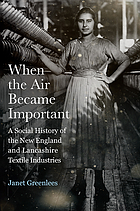 When the air became important : a social history of the New England and Lancashire textile industries
by
In When the Air Became Important, medical historian Janet Greenlees examines the working environments of the heartlands of the British and American cotton textile industries from the nineteenth to the late twentieth centuries. Greenlees contends that the air quality within these pioneering workplaces was a key contributor to the health of the wider communities of which they were a part. Such enclosed environments, where large numbers of people labored in close quarters, were ideal settings for the rapid spread of diseases including tuberculosis, bronchitis and pneumonia. When workers left the factories for home, these diseases were transmitted throughout the local population, yet operatives also brought diseases into the factory. Other aerial hazards common to both the community and workplace included poor ventilation and noise. Emphasizing the importance of the peculiarities of place as well as employers' balance of workers' health against manufacturing needs, Greenlees's pioneering book sheds light on the roots of contemporary environmentalism and occupational health reform. Her work highlights the complicated relationships among local business, local and national politics of health, and community priorities.
Call Number: eBookISBN: 9780813587974Publication Date: 2019
When the air became important : a social history of the New England and Lancashire textile industries
by
In When the Air Became Important, medical historian Janet Greenlees examines the working environments of the heartlands of the British and American cotton textile industries from the nineteenth to the late twentieth centuries. Greenlees contends that the air quality within these pioneering workplaces was a key contributor to the health of the wider communities of which they were a part. Such enclosed environments, where large numbers of people labored in close quarters, were ideal settings for the rapid spread of diseases including tuberculosis, bronchitis and pneumonia. When workers left the factories for home, these diseases were transmitted throughout the local population, yet operatives also brought diseases into the factory. Other aerial hazards common to both the community and workplace included poor ventilation and noise. Emphasizing the importance of the peculiarities of place as well as employers' balance of workers' health against manufacturing needs, Greenlees's pioneering book sheds light on the roots of contemporary environmentalism and occupational health reform. Her work highlights the complicated relationships among local business, local and national politics of health, and community priorities.
Call Number: eBookISBN: 9780813587974Publication Date: 2019 -
 White Collar
by
In print for fifty years, White Collar by C. Wright Mills is considered a standard on the subject of the new middle class in twentieth-century America. This landmark volume demonstrates how the conditions and styles of middle class life--originating from elements of both the newer lower andupper classes--represent modern society as a whole.By examining white-collar life, Mills aimed to learn something about what was becoming more typically "American" than the once-famous Western frontier character. He painted a picture instead of a society that had evolved into a business-based milieu, viewing America instead as a greatsalesroom, an enormous file, and a new universe of management.Russell Jacoby, author of The End of Utopia and The Last Intellectuals, contributes a new Afterword to this edition, in which he reflects on the impact White Collar had at its original publication and considers what it means to our society today."A book that persons of every level of the white collar pyramid should read and ponder. It will alert them to their condition for their better salvation."-Horace M. Kaellen, The New York Times (on the first edition)
Call Number: eBookISBN: 9780195157086Publication Date: 2002-09-26
White Collar
by
In print for fifty years, White Collar by C. Wright Mills is considered a standard on the subject of the new middle class in twentieth-century America. This landmark volume demonstrates how the conditions and styles of middle class life--originating from elements of both the newer lower andupper classes--represent modern society as a whole.By examining white-collar life, Mills aimed to learn something about what was becoming more typically "American" than the once-famous Western frontier character. He painted a picture instead of a society that had evolved into a business-based milieu, viewing America instead as a greatsalesroom, an enormous file, and a new universe of management.Russell Jacoby, author of The End of Utopia and The Last Intellectuals, contributes a new Afterword to this edition, in which he reflects on the impact White Collar had at its original publication and considers what it means to our society today."A book that persons of every level of the white collar pyramid should read and ponder. It will alert them to their condition for their better salvation."-Horace M. Kaellen, The New York Times (on the first edition)
Call Number: eBookISBN: 9780195157086Publication Date: 2002-09-26 -
 Women's Work?
by
American schoolteaching is one of few occupations to have undergone a thorough gender shift yet previous explanations have neglected a key feature of the transition: its regional character. By the early 1800s, far higher proportions of women were teaching in the Northeast than in the South, and this regional difference was reproduced as settlers moved West before the Civil War. What explains the creation of these divergent regional arrangements in the East, their recreation in the West, and their eventual disappearance by the next century? In "Women's Work" the authors blend newly available quantitative evidence with historical narrative to show that distinctive regional school structures and related cultural patterns account for the initial regional difference, while a growing recognition that women could handle the work after they temporarily replaced men during the Civil War helps explain this widespread shift to female teachers later in the century. Yet despite this shift, a significant gender gap in pay and positions remained. This book offers an original and thought-provoking account of a remarkable historical transition.
Call Number: eBookISBN: 9780226660417Publication Date: 2001-04-01
Women's Work?
by
American schoolteaching is one of few occupations to have undergone a thorough gender shift yet previous explanations have neglected a key feature of the transition: its regional character. By the early 1800s, far higher proportions of women were teaching in the Northeast than in the South, and this regional difference was reproduced as settlers moved West before the Civil War. What explains the creation of these divergent regional arrangements in the East, their recreation in the West, and their eventual disappearance by the next century? In "Women's Work" the authors blend newly available quantitative evidence with historical narrative to show that distinctive regional school structures and related cultural patterns account for the initial regional difference, while a growing recognition that women could handle the work after they temporarily replaced men during the Civil War helps explain this widespread shift to female teachers later in the century. Yet despite this shift, a significant gender gap in pay and positions remained. This book offers an original and thought-provoking account of a remarkable historical transition.
Call Number: eBookISBN: 9780226660417Publication Date: 2001-04-01 -
 Women, Work, and Place
by
Topics include the transformation of the work force in nineteenth-century Montreal (Bettina Bradbury), feminization of skill in the British garment industry (Allison Kaye), the relationship between work and family for Japanese immigrant women in Canada (Audrey Kobayashi), experiences of women during a labour dispute in Ontario (Joy Parr), contemporary restructuring of the labour force in the United States (Susan Christopherson) and in an urban context in Montreal (Damaris Rose and Paul Villeneuve), the effect of gentrification on women's work roles (Liz Bondi), inequality in the work force (Sylvia Gold), and theoretical issues involved in understanding women in the contemporary city (Linda Peake). An introductory essay provides a review of current issues. Feminists and women's studies specialists and activists as well as geographers, historians, sociologists, and policy planners will find this book of great interest.
Call Number: eBookISBN: 9780773564947Publication Date: 1994-01-01
Women, Work, and Place
by
Topics include the transformation of the work force in nineteenth-century Montreal (Bettina Bradbury), feminization of skill in the British garment industry (Allison Kaye), the relationship between work and family for Japanese immigrant women in Canada (Audrey Kobayashi), experiences of women during a labour dispute in Ontario (Joy Parr), contemporary restructuring of the labour force in the United States (Susan Christopherson) and in an urban context in Montreal (Damaris Rose and Paul Villeneuve), the effect of gentrification on women's work roles (Liz Bondi), inequality in the work force (Sylvia Gold), and theoretical issues involved in understanding women in the contemporary city (Linda Peake). An introductory essay provides a review of current issues. Feminists and women's studies specialists and activists as well as geographers, historians, sociologists, and policy planners will find this book of great interest.
Call Number: eBookISBN: 9780773564947Publication Date: 1994-01-01 -
 Women, Work, and Protest
by
As paid work becomes increasingly central in women's lives, the history of their labor struggles assumes more and more importance. This volume represents the best of the new feminist scholarship in twentieth-century U.S. women's labor history. Fourteen original essays illuminate the complex relationship between gender, consciousness and working-class activism, and deepen historical understanding of the contradictory legacy of trade unionism for women workers. The contributors take up a wide range of specific subjects, and write from diverse theoretical perspectives. Some of the essays are case studies of women's participation in individual unions, organizing efforts, or strikes; others examine broader themes in women's labor history, focusing on a specific time period; and still others explore the situation of particular categories of women workers over a longer time span. This collection extends the scope of current research and interpretation in women's labor history, both conceptually and in terms of periodization - emphasis is placed on the post-World War I period where the literature is sparse. This book will be valuable for scholars, students and general readers alike.
Call Number: eBookISBN: 9781136247699Publication Date: 2013-05-07
Women, Work, and Protest
by
As paid work becomes increasingly central in women's lives, the history of their labor struggles assumes more and more importance. This volume represents the best of the new feminist scholarship in twentieth-century U.S. women's labor history. Fourteen original essays illuminate the complex relationship between gender, consciousness and working-class activism, and deepen historical understanding of the contradictory legacy of trade unionism for women workers. The contributors take up a wide range of specific subjects, and write from diverse theoretical perspectives. Some of the essays are case studies of women's participation in individual unions, organizing efforts, or strikes; others examine broader themes in women's labor history, focusing on a specific time period; and still others explore the situation of particular categories of women workers over a longer time span. This collection extends the scope of current research and interpretation in women's labor history, both conceptually and in terms of periodization - emphasis is placed on the post-World War I period where the literature is sparse. This book will be valuable for scholars, students and general readers alike.
Call Number: eBookISBN: 9781136247699Publication Date: 2013-05-07 -
 Work and Labor in the Digital Age
by
This volume presents the most recent studies of work and labor in the digital age as it unfolds in both Europe and the United States. One of the critical questions facing modernity concerns the reconfiguration of paid employment, which has been subject to wholesale changes that have widespread consequences for workers, their families, and the institutional structure that characterizes capitalist societies. A key driver of these changes has been the digital revolution and the rapid proliferation of the gig economy. Together with social network sites for hiring, the spread of robotics, and the rise of artificial intelligence and machine learning, they leave virtually no occupation untouched.
Call Number: eBookISBN: 9781789735871Publication Date: 2019-07-04
Work and Labor in the Digital Age
by
This volume presents the most recent studies of work and labor in the digital age as it unfolds in both Europe and the United States. One of the critical questions facing modernity concerns the reconfiguration of paid employment, which has been subject to wholesale changes that have widespread consequences for workers, their families, and the institutional structure that characterizes capitalist societies. A key driver of these changes has been the digital revolution and the rapid proliferation of the gig economy. Together with social network sites for hiring, the spread of robotics, and the rise of artificial intelligence and machine learning, they leave virtually no occupation untouched.
Call Number: eBookISBN: 9781789735871Publication Date: 2019-07-04 -
 Working class : challenging myths about blue-collar labor
by
Jeff Torlina challenges the conventional wisdom about the attitudes of blue-collar men toward their work. Torlina highlights the voices of pipe fitters, welders, carpenters, painters, locomotive assemblers, and factory workers to reveal the complexities, and advantages, of working-class life. These men see blue-collar labor as a desirable alternative to white-collar occupations; their work involves integrity, character, pride, and a connection with being a real man; values that they perceive as lost in white-collar office jobs. The result is a penetrating critique of many commonly held assumptions, and a compelling case for a new understanding of our social class system
Call Number: eBookISBN: 9781588269775Publication Date: 2011
Working class : challenging myths about blue-collar labor
by
Jeff Torlina challenges the conventional wisdom about the attitudes of blue-collar men toward their work. Torlina highlights the voices of pipe fitters, welders, carpenters, painters, locomotive assemblers, and factory workers to reveal the complexities, and advantages, of working-class life. These men see blue-collar labor as a desirable alternative to white-collar occupations; their work involves integrity, character, pride, and a connection with being a real man; values that they perceive as lost in white-collar office jobs. The result is a penetrating critique of many commonly held assumptions, and a compelling case for a new understanding of our social class system
Call Number: eBookISBN: 9781588269775Publication Date: 2011 -
 Working Memory
by
Working Memory: Women and Work in World War II speaks to the work women did during the war: the labour of survival, resistance, and collaboration, and the labour of recording, representing, and memorializing these wartime experiences. The contributors follow their subjects' tracks and deepen our understanding of the experiences from the imprints left behind. These efforts are a part of the making of history, and when the process is as personal as many of our contributors' research has been, it is also the working of memory. The implication here is that memory is intimate, and that the layering of narrative fragments that recovery involves brings us in touching distance to ourselves. These are not the stories of the brave little woman at home; they are stories of the woman who calculated the main chance and took up with the Nazi soldier, or who eagerly dropped the apron at the door and picked up a paintbrush, or who brazenly bargained for her life and her mother's with the most feared of tyrants. These are stories of courage and sometimes of compromise-- not the courage of bravado and hype and big guns, but rather the courage of hard choices and sacrifices that make sense of the life given, even when that life seems only madness. Working Memory brings scholarly attention to the roles of women in World War II that have been hidden, masked, undervalued, or forgotten.
Call Number: eBookISBN: 9781771120371Publication Date: 2015-07-31
Working Memory
by
Working Memory: Women and Work in World War II speaks to the work women did during the war: the labour of survival, resistance, and collaboration, and the labour of recording, representing, and memorializing these wartime experiences. The contributors follow their subjects' tracks and deepen our understanding of the experiences from the imprints left behind. These efforts are a part of the making of history, and when the process is as personal as many of our contributors' research has been, it is also the working of memory. The implication here is that memory is intimate, and that the layering of narrative fragments that recovery involves brings us in touching distance to ourselves. These are not the stories of the brave little woman at home; they are stories of the woman who calculated the main chance and took up with the Nazi soldier, or who eagerly dropped the apron at the door and picked up a paintbrush, or who brazenly bargained for her life and her mother's with the most feared of tyrants. These are stories of courage and sometimes of compromise-- not the courage of bravado and hype and big guns, but rather the courage of hard choices and sacrifices that make sense of the life given, even when that life seems only madness. Working Memory brings scholarly attention to the roles of women in World War II that have been hidden, masked, undervalued, or forgotten.
Call Number: eBookISBN: 9781771120371Publication Date: 2015-07-31 -
 A working people : a history of African American workers since emancipation
by
In African Americans at Work, historian Steven A. Reich examines the economical, political and cultural forces that have built and broken America's black workforce for centuries. From the abolition of slavery through the civil rights movement and Great Recession, African Americans have been singularly disadvantaged members of the workforce, repeatedly denied access to the opportunities all Americans are to be afforded under the Constitution.
Call Number: eBookISBN: 9781442203334Publication Date: 2013
A working people : a history of African American workers since emancipation
by
In African Americans at Work, historian Steven A. Reich examines the economical, political and cultural forces that have built and broken America's black workforce for centuries. From the abolition of slavery through the civil rights movement and Great Recession, African Americans have been singularly disadvantaged members of the workforce, repeatedly denied access to the opportunities all Americans are to be afforded under the Constitution.
Call Number: eBookISBN: 9781442203334Publication Date: 2013 -
 Work in the Age of Robots
by
Are robots finally replacing humans' Does the emerging age of artificial intelligence and automation mean we will soon see "peak jobs" and the need for a Universal Basic Income to support a widening swath of hapless citizens unsuited for employment in a primarily "knowledge" workforce' Improving productivity-reducing labor hours per unit of product or service-has been the hallmark of economic progress for centuries. But advances due to robots and AI, some say, will be fundamentally different because digital machines are ready to revolutionize the nature of work in nearly every sector, not just one or two. But the lessons of history and the realities of technologies suggest that, despite yet more disruption, the overall result will be net job gains and faster economic growth.
Call Number: eBookISBN: 9781641770286Publication Date: 2018
Work in the Age of Robots
by
Are robots finally replacing humans' Does the emerging age of artificial intelligence and automation mean we will soon see "peak jobs" and the need for a Universal Basic Income to support a widening swath of hapless citizens unsuited for employment in a primarily "knowledge" workforce' Improving productivity-reducing labor hours per unit of product or service-has been the hallmark of economic progress for centuries. But advances due to robots and AI, some say, will be fundamentally different because digital machines are ready to revolutionize the nature of work in nearly every sector, not just one or two. But the lessons of history and the realities of technologies suggest that, despite yet more disruption, the overall result will be net job gains and faster economic growth.
Call Number: eBookISBN: 9781641770286Publication Date: 2018


eBook Academic Collection (EBSCO)
- eBooks on a variety of topics covering disciplines such as History, Social Sciences, Law, Literature and more.
eBook Central (ProQuest)
- NOTE: From ON and OFF campus, you will be brought to the "Sign into your JWU email" page to log onto the University's network.
History Reference eBook Collection
- historical eBook titles covering global topics from the ancient world through today.
Check out the JWU library style guide:
However, if you need more in depth guidance on formatting go to the Purdue OWL.
Need to talk to someone and seek guidance in real time?
- If you are a PVD campus student you can schedule an appointment with the writing coach through uSucceed.
